
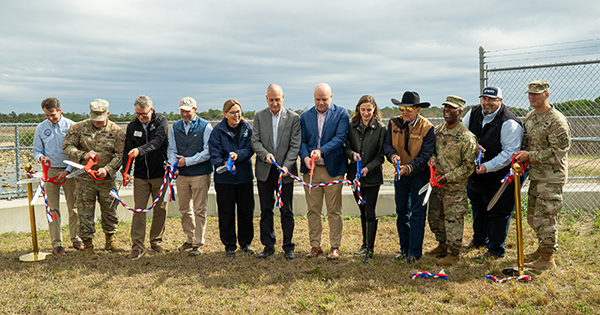
COLLIER COUNTY, Fla. - The South Florida Water Management District (SFWMD), the U.S. Army Corps of Engineers (USACE) and the Florida Department of Environmental Protection along with many other federal, state and local officials, partners and stakeholders celebrated the completion of the Picayune Strand Restoration Project in Collier County. The Picayune Strand Restoration Project is a cornerstone of America’s most ambitious ecosystem restoration effort, the Comprehensive Everglades Restoration Plan (CERP). The completion of this project means that another major CERP project is complete!
"Today we celebrated a significant step toward protecting Floridians from flood risk and restoring America’s Everglades. It is a great honor to be here as we mark the completion of the Picayune Strand Restoration Project, a cornerstone of the Comprehensive Everglades Restoration Plan," said Adam Telle, Assistant Secretary of the Army for Civil Works. "Reducing flood risk to Floridians and completing rejuvenation of this natural wonder is a gargantuan challenge, the type that can only be successfully pulled off under the get-it-done leadership of President Trump and his Administration. The amount of time and effort that we are contributing to this project is extraordinary, and the result is a testament to the hard work of the U.S. Army Corps of Engineers, our partners with the State of Florida, and everyone involved in making today a reality."
“Thanks to the support of Governor Ron DeSantis and the Florida Legislature and their steadfast commitment to Everglades restoration, we are seeing what is possible when state and federal governments, along with our partners, commit to this work and follow through,” said Alexis A. Lambert, Secretary of the Florida Department of Environmental Protection. “This project is already improving water quality and wildlife habitat and helping ensure America’s Everglades are stronger for generations to come.”
“Historic Achievement. Monumental Day. Collaboration at its finest! We have worked for decades to get to the finish line of this vital Everglades restoration project,” said Charlette Roman, South Florida Water Management District Governing Board Member and Chair of the Big Cypress Basin. “I am enormously grateful to every single person who worked on this project every step of the way. The momentum we have seen under the leadership of Governor Ron DeSantis is truly amazing. In recent years, we have seen many large-scale projects come on-line, with more in the works. Only by working together with the U.S. Army Corps of Engineers and all of our federal, state and local partners and stakeholders can we accomplish these monumental feats of engineering, planning and construction. I am so proud to be a part of the critical effort to restore America’s Everglades and can finally say, we completed the Picayune Strand Restoration Project!”
Spanning 55,000 acres between Alligator Alley and Tamiami Trail in Southwest Florida, this restoration project is the result of years of collaboration among USACE and the SFWMD, as well as many local, state, and federal partners. Through the removal of 260 miles of roads and plugging 48 miles of canals, the project has successfully restored the natural flow of water to the region, revitalizing wetlands and improving overall water quality.
This restoration project will improve flows of water into Collier Seminole State Park, Ten Thousand Islands National Wildlife Refuge and the Rookery Bay National Estuarine Research Reserve.
The project has numerous environmental benefits including:
- Restoration of wetlands that are already making a significant contribution to the landscape of Southwest Florida
- Restored and enhanced habitat for fish and wildlife including the Florida Panther
- Reduced drainage of adjacent sensitive ecosystems
- Improved aquifer recharge to protect underground water supplies and prevent saltwater intrusions
- Reduced freshwater releases/improved health of downstream estuaries
These long-term benefits will ensure that the region’s natural resources are safeguarded for generations to come.
CERP projects are coming online at a historic pace and significant progress continues to be made to implement projects that support the ecological health of Florida’s unique ecosystem.
Recent accomplishments include:
- Recognized the 25th Anniversary of the Comprehensive Everglades Restoration Plan and the incredible progress that has been made in transforming how water moves across Florida.
- Celebrated the completion of the Biscayne Bay Coastal Wetlands Project, a major CERP project. This project improves the health of Biscayne Bay and aids in wetland rehydration — building coastal resiliency and improving water quality in this area of Miami-Dade County.
- Broke ground on the Everglades Agricultural Area (EAA) Reservoir Inflow Pump Station in Palm Beach County, which will have the capability to move approximately 3 billion gallons of water per day from Lake Okeechobee into the EAA Reservoir.
- Broke ground on the Blue Shanty Flow Way in Miami-Dade County, a vital system that will deliver clean water south across Tamiami Trail and into Florida Bay.
- Start-up of the Caloosahatchee (C-43) Reservoir in Hendry County.
- Signing of a landmark agreement between the State of Florida and the U.S. Department of the Army to accelerate Everglades restoration, including the EAA Reservoir. This agreement supercharges Everglades restoration by accelerating the EAA Reservoir’s construction timeline by five years—from 2034 to 2029.
The Picayune Strand Restoration Project is a partnership between the USACE and the SFWMD. In 2009, it was the first Project Partnership Agreement that the USACE executed with the SFWMD as part of the Comprehensive Everglades Restoration Plan.
The State of Florida and the U.S. Army Corps of Engineers have completed, broken ground or reached a major milestone on more than 80 Everglades restoration projects since 2019.
Media Resources
Download Video from the Picayune Strand Restoration Project Ribbon Cutting
Download B-Roll of the Picayune Strand Restoration Project
Download Photos from the Picayune Strand Restoration Project Ribbon Cutting